Friday, February 5, 2010

EVENT: Early heads-up on National Direct Instruction Conference AND a new conference tailored for Direct Instruction for students with ASD

Although Precision Teaching is a measurement technology that can be applied to any curriculum, many Precision Teachers have found considerable value in using the Direct Instruction programs - and such was the subject of an article by Carl Binder, Precision Teacher and Cathy Watkins, Direct Instructor,
Binder, C., & Watkins, C. L. (1990). Precision Teaching and Direct Instruction: Measurably superior instructional technology in schools. Performance. Improvement Quarterly, 3(4), 74-96.

For that reason we'd like to give an early heads-up on two summer conferences of interest to those who use the Direct Instruction (Becker, Englemann) model of instruction or are interested in learning more about it and specific curriculum packages-
the
  • 36th National Direct Instruction Conference And Institutes, which will be held in Eugene, Oregon and
  • Effective Programs for Learners With Autism Spectrum Disorders—A Direct Instruction Conference, Columbus, Ohio. (As a special note, the Columbus, Ohio conference is being hosted in cooperation with Haugland Learning Center).

36th National Direct Instruction Conference And Institutes July 25–29, 2010
Hilton Eugene Hotel & Conference Center
Eugene, Oregon

Beginning and Advanced Training
College Credit
BACB® Approved Continuing Education Units available


"Join us for the longest running, most comprehensive Direct Instruction Training available.

This year we are pleased to present long time DI Consultant Carolyn Schneider along with Zig Engelmann as our keynote speakers.

We will have sessions for beginning and veteran users, as well as sessions designed for classroom teachers and parapros, coaches, and administrators. Special tracks for general, and special education and many others will be highlighted"

Please see the conference brochure for full information on events, registration and lodging.

Questions about the National Direct Instruction Conference should be directed to the Association for Direct Instruction


AND a new special focus Direct Instruction Conference in Columbus, Ohio

Effective Programs for Learners With Autism Spectrum Disorders—A Direct Instruction Conference, Columbus, Ohio
August 16–18, 2010
Hilton Columbus/Polaris
Columbus, Ohio

BACB® Approved Continuing Education Units available!
College Credit Available!
Training Designed for Teachers, Practitioners and Parents!

"Training on Reading Mastery, Language for Learning, DISTAR Arithmetic, Connecting Math Concepts and Corrective Reading Comprehension will be featured at this training tailored specifically for those that work with students with an ASD diagnosis."
[Blog author note - for information on these curriculum packages, see Signals, The Direct Instruction Community]

Please see the conference brochure for full information on events, registration and lodging.

Questions about the Effective Programs for Learners With Autism Spectrum Disorders conference should be directed to the Association for Direct Instruction

--------------------
DISCLAIMER: Information is posted for informational or educational purposes of readers but is not, nor claims to be, an official outlet of the Standard Celeration Society or any other organization or business.
Readers are directed to seek definitive information from those primary sources


Tuesday, February 2, 2010

Preliminary announcement of the 2010 International Precision Teaching Conference - Seattle, WA

Mark your calendars!

23rd International Precision Teaching Conference/ IPTC 2010
- Seattle, WA
Thurs. November 4th- Sat. November 6th, 2010
**Please see the note below that a group reservation code for the hotel group rate is not yet available, but is anticipated to be available in the very near future - that info will posted/shared in a future post when it becomes so. Announcements and info on IPTC 2010 should also be appearing shortly at celeration.org.
Thanks for your understanding**

23rd International Precision Teaching Conference/ IPTC 2010
- Seattle, WA
Thursday November 4th- Saturday November 6th, 2010
 

Holiday Inn, SEATTLE
211 DEXTER AVE NORTH, SEATTLE, WA 98109
Hotel Front Desk: 1-206-728-8123 | Hotel Fax: 1-206-728-2779
Group Reservation Code: TBA/To be announced when available

Airport: Sea-Tac International Airport

Thanks and appreciation to Kris Melroe, Kelly Ferris and all of the good folks in Seattle working as local hosts to put together IPTC 2010.

------------------
All posts under label of IPTC

-----------------
DISCLAIMER: Information is posted for informational or educational purposes of readers but is not, nor claims to be, an official outlet of the Standard Celeration Society or any other organization or business.
Readers are directed to seek definitive information from those primary sources
 

Saturday, January 30, 2010

BLAST FROM THE PAST (1971 & '72) A couple of rare Precision Teaching references available

Just want to gives a heads-up on a couple of historical Precision Teaching references that have some citation in the field's literature, but have not been necessarily easily available,


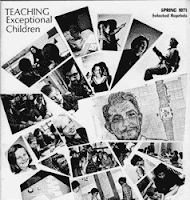
1971 - Teaching Exceptional Children 3(3) - which was a special issue on Precision Teaching and reprinted in a "selected reprint" volume in 1975.

Copies of this reprint are available at a nominal cost at Behavior Research Company.


Contents:
  • Johnson, E.C. (1971). Precision teaching helps children learn. Teaching Exceptional Children, 3, 106-110.
  • Bates, S., & Bates, D. F. (1971). ... and a child shall lead them:Stephanie's chart story. Teaching Exceptional Children, 3, 111-113. [Also see the slideshow at the Behavior Research Company website.]
  • Lindsley, O. R. (1971) Precision teaching in perspective: An interview. Teaching Exceptional Children, 3, 114-119.
  • Galloway, C., & Galloway, K.C. (1971). Parent classes in precise behavior management. Teaching Exceptional Children, 3, 120-128.
  • Starlin, C. (1971). Peers and precision. Teaching Exceptional Children, 3, 129-132, 137-140.
  • Haughton, E.C. (1971). Great gains from small starts. Teaching Exceptional Children, 3, 141-146.
  • Cohen, M.A., & Grant, M.L. (1971). Applying precision teaching to academic assessment. Teaching Exceptional Children, 3, 147-150.
  • Duncan, A. D. (1971). The view for the inner eye: Personal management of inner and outer behaviors. Teaching Exceptional Children, 3, 152-156.
  • Koenig, C. (1971). The behavior bank: A system for sharing precise information. Teaching Exceptional Children, 3, 157.

The second has recently become available in open access pdf from the Education Resources Information Center (ERIC) database, and while there are some limits on the quality of the reproduction (black and white, and some layout issues), it does allow an interested audience access to the text of the publication.


1972 - J. B.Jordan and L. S. Robins, Eds. Let's try doing something else kind of thing: Behavior principles and the exceptional child. Reston, VA: The Council for Exceptional Children - which was a published report on the Invisible College* Conference on the Application of Behavioral Principles in Exceptional Child Education. March 25-26, 1971. Conference Chairmen: Sidney W. Bijou, Ogden R. Lindsley, Eric Haughton
ERIC#: ED060581

Contents (please note that some of the page numbers may only be approximate due to the nature of the ERIC reprint, so please verify numbering and other info for before using for any citation purpose.)
  • Authors III
  • Preface VII -X.
  • Lindsley, O.R. From Skinner to precision teaching: The child knows best. 1-11.
  • Starlin, A. Sharing a message about curriculum with my teacher friends. 12-19.
  • Haughton, E. Aims - Growing and Sharing. 20-39 
  • Johnson, T.G. Precision therapy is the way to go. 40-50.
  • Duncan, A.D. The gifted count and chart. 51-55.
  • Young, B. J. Imagine you're the parent of a deaf-blind child. 57-65.
  • Bijou, S.W. The kids have problems and our job is to do something for them.68-75.
  • Phillips, D. We have a successful tool now - Let's use it! 76-83.
  • Johnson, N. Precision teaching cuts across cultural lines. 84-91.
  • Galloway, C. Precision parents and the development of retarded behavior.93-109.
  • Caldwell, T.E. Teacher training tools for precision. 111-117.
  • Kunzelmann, H. For successful program maintenance: Look at the data first. 118-126
  • Selected Readings. 127-129
  • Selected Resources. 129.
-----------------------------------
"Invisible College": Scientific communication conducted through an informal channel.
An early source for this information-sharing model is,
Allen, T.J., & S.I. Cohen (1969), ‘ Information flow in research and development laboratories’. Administrative Science Quarterly, 14, 12-19.

Education Resources Information Center (ERIC)
An online digital library of education research and information. ERIC is sponsored by the Institute of Education Sciences (IES) of the U.S. Department of Education. ERIC provides ready access to education literature to support the use of educational research and information to improve practice in learning, teaching, educational decision-making, and research.

--------------------
DISCLAIMER: Information is posted for informational or educational purposes of readers but is not, nor claims to be, an official outlet of the Standard Celeration Society or any other organization or business.
Readers are directed to seek definitive information from those primary sources

Friday, January 29, 2010

A New Precision Teacher in the Blogsphere

I think there's a new convert to Precision Teaching out in the blogsphere (smile).

Jennie at Nurture A Reader recently posted a complimentary blog post on how timing and charting, and using the chart to make informed instructional decisions is improving learning for her students, and "empowering" her - that's excellent news.

(And, by the way - Nurture A Reader was a great discovery, with interesting posts and a useful set of links and resources on teaching reading. Check it out.)

Wednesday, January 27, 2010
Nurture A Reader
Timed Drills
"I used to think that DRILLING and TIMING was NUTS. . . ."
There's also an earlier post on an article by Rick Kubina and Clay Starlin which was published in the European Journal of Behavior Analysis, 4( 1&2).
 
Thursday, January 7, 2010
Nurture A Reader
Precision Teaching and Reading Instruction


--------------------
DISCLAIMER: Information is posted for informational or educational purposes of readers but is not, nor claims to be, an official outlet of the Standard Celeration Society or any other organization or business.
Readers are directed to seek definitive information from those primary sources

Friday, January 15, 2010

John Locke Foundation Bestowes Pope Award on Baker Mitchell of Roger Bacon Academy


With apologies to Baker Mitchell, and the staff and students under the aegis of the Roger Bacon Academy, Leland, North Carolina for being somewhat tardy with these congratulations, I would like to not only applaud Baker for the recognition by the John Locke Foundation but to also highlight the outstanding work being done in using Direct Instruction and Precision Teaching with the students at their free and public charter schools - Charter Day School in Leland, NC. and Columbus Day School in Whitterville, NC.

On a related note, they are currently taking applications for both the Charter Day School and Columbus Day School during their open enrollment through January 31st
"Baker Mitchell collected the John William Pope Sr. Award for the Advancement of Freedom in North Carolina...

Before a crowd of 475 people, JLF President John Hood touted Mitchell's work in starting Charter Day School in Leland, NC which now has 750 students in grades K-8, and Columbus Charter School, with 350 students in grades K-4 registered for the upcoming year.

"The astounding thing to note is that with nearly 30 percent less money, these public charter schools have 40 percent more of their economically disadvantaged students score proficient on the state tests than the state's average for all students," Hood said.
...Mitchell started the Brunswick school in 2000 with 53 students in grades K-2. Its academic successes have attracted families from five surrounding counties, Hood said. "We try to work closely with the traditional public schools in the area and with UNC-Wilmington to share our instructional model so it can be more widely disseminated," Mitchell added.


Mitchell said. "I believe every staff member is keenly aware of the freedom that parents have to enroll or withdraw their children in these tuition-free public schools. Everyone knows their job depends upon being responsive to each student's needs and that every child can learn when properly taught."
FULL STORY


----------------------------------------
For further reading and followup


Video of reading triads
Daily grades 1-8
Based on a procedure introduced to the Academy by Michael Maloney of "Teach Your Children Well"

Roger Bacon Academy Leads the Way With Basics
Two southeastern N.C. charter schools showing positive results
By Hal Young, Carolina Journal
February 26, 2009


How a charter school found success
Saturday, June 6, 2009
StarNews Online


Charter Day School Tops List in Brunswick, Columbus Counties for Highest ABC Scores
Direct instruction with systematic phonics, basic math facts credited with success

Other Achievements and Projects of Charter Day School/Roger Bacon Academy

--------------------
DISCLAIMER: Information is posted for informational or educational purposes of readers but is not, nor claims to be, an official outlet of the Standard Celeration Society or any other organization or business.
Readers are directed to seek definitive information from those primary sources


Monday, December 28, 2009

NEWS: Beal Street Academy, Hingham, MA given certification by state of Massachusetts


The Massachusetts Department of Elementary and Secondary Education issued a certificate of Provisional Approval, the first level approval, to
Beal Street Academy
, Hingham, Massachusetts, on September 4, 2009.  “We have been working toward this approval for three years—it is a terrific and important step for students and families on the South Shore. Beal Street Academy will teach students ages 13-22 who have fallen substantially behind in their schoolwork,” said Richard McManus,  Founder and Executive Director.  “Many people have worked very hard to achieve this recognition, including parents who dearly wanted this school to exist, and our staff, who persevered despite many obstacles.”
Beal Street Academy's Mission Statement
Beal Street Academy will provide an intense education intervention to increase student academic performances by at least two years for each year in the program.
McManus reports that the school can now accept referrals from cities and towns, and knows that there are quite a few students whose needs will be filled by the school’s excellent curriculum and teaching approach.  “We use Precision Teaching, a highly validated and successful approach to teach students to excel in their work.  We use the same approach that we have used for seven very successful years at The Fluency Factory , our tutoring center, but now we will have sufficient time and resources to help students with learning disabilities to attain far more success than they previously have achieved.”
"...When the Strazzulas informed McManus that their child had no attention span, could not recognize his own name in print, and had learned some sight words but never seemed to hold on to what he learned, McManus was undaunted.
'Great, send him! was Richard’s response,' Strazzulla said. 'James loves going to school here. At first progress was very slow, . . . but now he reads for pleasure and sets high goals for himself. And why not? People are dreaming for him now. He has far exceeded our expectations, and we hope he will be an example to others of never giving up. . . . He just finished his fifth Harry Potter book and is now reading the sixth. . . . The sky’s the limit now.”..."

Rosemary Littlefield, the school’s Principal, has been very impressed by the progress that Beal Street has made in a very short time.  “I have been involved with several other schools during my career, but this is the first time I have worked to launch a new school.  The approval process was very challenging, but we worked together and made it happen.”  McManus says, “Diane Evans, our Head Teacher, was so important to the application process—it would have been impossible without her.”  The school, though newly approved, already has several referrals and will be adding students during the school year.  Ultimately it will serve 20 students.
------------------------------------
Related stories and blogposts

State gives provisional OK to special needs school in Hingham
The Patriot Ledger,
September 9, 2009


Beal Street Academy fills a growing need

Articles on the Fluency Factory, Beal Street Academy, and written by Richard McManus
At the Fluency Factory

Sunday, November 15, 2009
ANNOUNCE: Nov. 22, 2009 Hingham, MA - Richard McManus to Speak on "Do Expectations Determine Outcomes?"

Thursday, June 4, 2009
OPPORTUNITY: Hingham, MA Summer Programs at The Fluency Factory

-----------------
DISCLAIMER: Information is posted for informational or educational purposes of readers but is not, nor claims to be, an official outlet of the Standard Celeration Society or any other organization or business.
Readers are directed to seek definitive information from those primary sources

Morningside Academy interviewing for Fall 2010 Admissions

The Morningside Academy (Seattle WA) website states that they are currently interviewing for admissions to Morningside for Fall 2010.

Past posts on Morningside Academy

Monday, November 23, 2009
Kent Johnson awarded 2009 Ernie Wing Award for Excellence in Evidence-based Education

Wednesday, June 3, 2009
OPPORTUNITY: Summer Programs for Students & Teachers at Morningside Academy, Seattle, WA

--------------------
DISCLAIMER: Information is posted for informational or educational purposes of readers but is not, nor claims to be, an official outlet of the Standard Celeration Society or any other organization or business.
Readers are directed to seek definitive information from those primary sources