
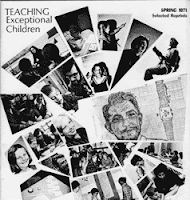
1971 - Teaching Exceptional Children 3(3) - which was a special issue on Precision Teaching and reprinted in a "selected reprint" volume in 1975.
Copies of this reprint are available at a nominal cost at Behavior Research Company.
Contents:
- Johnson, E.C. (1971). Precision teaching helps children learn. Teaching Exceptional Children, 3, 106-110.
- Bates, S., & Bates, D. F. (1971). ... and a child shall lead them:Stephanie's chart story. Teaching Exceptional Children, 3, 111-113. [Also see the slideshow at the Behavior Research Company website.]
- Lindsley, O. R. (1971) Precision teaching in perspective: An interview. Teaching Exceptional Children, 3, 114-119.
- Galloway, C., & Galloway, K.C. (1971). Parent classes in precise behavior management. Teaching Exceptional Children, 3, 120-128.
- Starlin, C. (1971). Peers and precision. Teaching Exceptional Children, 3, 129-132, 137-140.
- Haughton, E.C. (1971). Great gains from small starts. Teaching Exceptional Children, 3, 141-146.
- Cohen, M.A., & Grant, M.L. (1971). Applying precision teaching to academic assessment. Teaching Exceptional Children, 3, 147-150.
- Duncan, A. D. (1971). The view for the inner eye: Personal management of inner and outer behaviors. Teaching Exceptional Children, 3, 152-156.
- Koenig, C. (1971). The behavior bank: A system for sharing precise information. Teaching Exceptional Children, 3, 157.
The second has recently become available in open access pdf from the Education Resources Information Center (ERIC) database, and while there are some limits on the quality of the reproduction (black and white, and some layout issues), it does allow an interested audience access to the text of the publication.

1972 - J. B.Jordan and L. S. Robins, Eds. Let's try doing something else kind of thing: Behavior principles and the exceptional child. Reston, VA: The Council for Exceptional Children - which was a published report on the Invisible College* Conference on the Application of Behavioral Principles in Exceptional Child Education. March 25-26, 1971. Conference Chairmen: Sidney W. Bijou, Ogden R. Lindsley, Eric Haughton
ERIC#: ED060581
Contents (please note that some of the page numbers may only be approximate due to the nature of the ERIC reprint, so please verify numbering and other info for before using for any citation purpose.)
- Authors III
- Preface VII -X.
- Lindsley, O.R. From Skinner to precision teaching: The child knows best. 1-11.
- Starlin, A. Sharing a message about curriculum with my teacher friends. 12-19.
- Haughton, E. Aims - Growing and Sharing. 20-39
- Johnson, T.G. Precision therapy is the way to go. 40-50.
- Duncan, A.D. The gifted count and chart. 51-55.
- Young, B. J. Imagine you're the parent of a deaf-blind child. 57-65.
- Bijou, S.W. The kids have problems and our job is to do something for them.68-75.
- Phillips, D. We have a successful tool now - Let's use it! 76-83.
- Johnson, N. Precision teaching cuts across cultural lines. 84-91.
- Galloway, C. Precision parents and the development of retarded behavior.93-109.
- Caldwell, T.E. Teacher training tools for precision. 111-117.
- Kunzelmann, H. For successful program maintenance: Look at the data first. 118-126
- Selected Readings. 127-129
- Selected Resources. 129.
"Invisible College": Scientific communication conducted through an informal channel.
An early source for this information-sharing model is,
Allen, T.J., & S.I. Cohen (1969), ‘ Information flow in research and development laboratories’. Administrative Science Quarterly, 14, 12-19.
Education Resources Information Center (ERIC)
An online digital library of education research and information. ERIC is sponsored by the Institute of Education Sciences (IES) of the U.S. Department of Education. ERIC provides ready access to education literature to support the use of educational research and information to improve practice in learning, teaching, educational decision-making, and research.
--------------------
DISCLAIMER: Information is posted for informational or educational purposes of readers but is not, nor claims to be, an official outlet of the Standard Celeration Society or any other organization or business.
Readers are directed to seek definitive information from those primary sources
DISCLAIMER: Information is posted for informational or educational purposes of readers but is not, nor claims to be, an official outlet of the Standard Celeration Society or any other organization or business.
Readers are directed to seek definitive information from those primary sources


